Time Shift
Time Shift is a 3D first-person puzzle game developed as part of a group project at UC Irvine. Players must travel between the present and future to manipulate the environment and solve increasingly complex puzzles.
Level Design
As sole level designer I was tasked with developing an interesting game with just the time shifting mechanics. As this game was for a class, we wanted to create a powerful vertical slice that we could present in a few months time.
The game starts the player in a cell covered in “wall scrawls” that tell the player to right click the mouse to “shift” times, and the only way to progress is by “shifting” time to the future. This teaches the player the mechanics of time shifting as early as possible, and shows that obstacles, even walls, need to be overcome by “shifting” time. It also improves immersion since there are no menus that pop up to demonstrate this to the player. It forces the player to learn by doing, which in my experience, is the best way to learn something.
The next puzzle demonstrates the next mechanic of the present affecting the future. The player needs to get up to a ledge in the future world but can’t because the block they can climb on is behind a wall. This wall is not in the present, however, so the player must realize they can move the block in the present and “shift” back into the future to move onto the next section.
The next section is a succession of puzzles that build complexity on these mechanics. Below is a video walkthrough of the successive puzzles that lead towards the main room. This game is unfinished as it was created primarily for a class project.
Gameplay Design
While the gameplay itself is fairly simple, just shifting times back and forth, the game is not that simple. I wanted to develop an interesting advancement of this concept, so I implemented a mechanic that allows the present to affect the future. This allowed puzzles to become much more 3 dimensional which was not possible when the only mechanic was travelling between the times. I did this to avoid “lock and key” puzzles where the answers were linear and only required one action to move towards the next puzzle.
An example of this is the very first puzzle, where the player must move a block in the present to an area that is walled off in the future but where the player can still access by shifting times. This allows the player to move onto the next section and takes 3 actions to pass the puzzle, instead of just 1.
Production
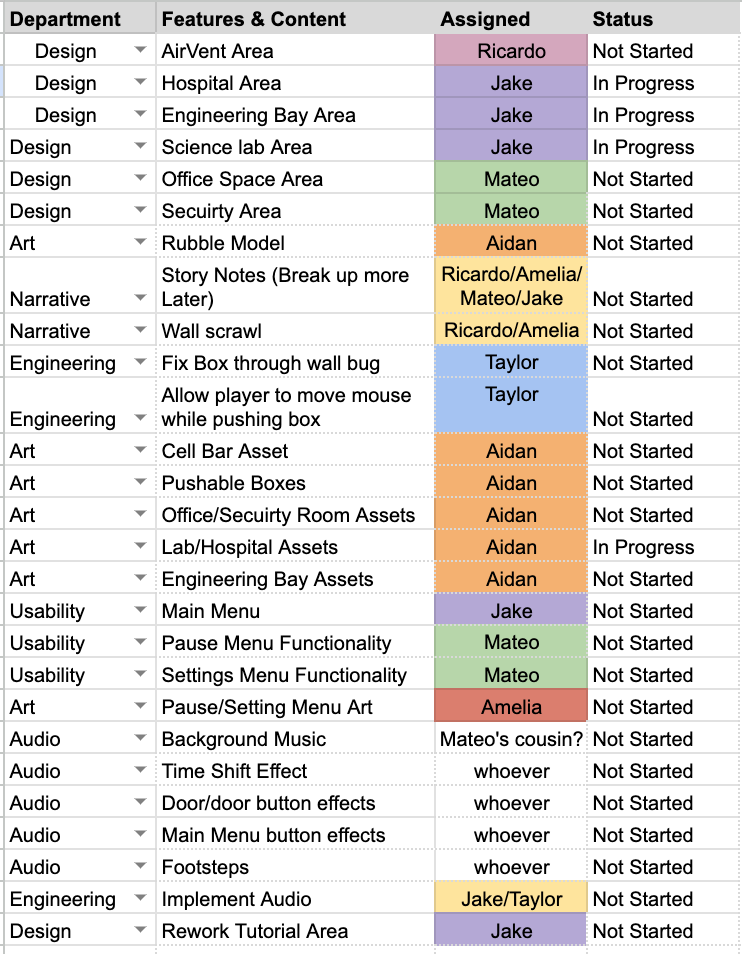
As team lead, I was responsible for task planning, delegation, and progress tracking using a shared Google Sheet. Despite the small team size, maintaining organization was critical to keeping development on schedule.
I held two weekly meetings: one to assign tasks and set goals, and another to review progress and adjust workloads as needed. This structure allowed the team to remain flexible while balancing the constraints of a student schedule.